As civic space in Serbia continues to shrink, the challenge for civil society and independent media is not only to withstand pressure, but also to adapt and remain effective. Drawing on experiences from the ACT project, implemented in Serbia with the support of the Swiss Agency for Development and Cooperation (SDC), project manager Gorana Radovanović shares key insights into how targeted capacity building, community engagement, and principled participation can strengthen resilience and democratic practice in highly polarized circumstances.
1. Based on ACT’s experience, what are the key capacities that civil society organizations and independent media need in order to remain resilient and effective in a restrictive political environment?
Over the past six years, ACT has worked with more than 200 civil society organizations across Serbia. They differ in size, focus, and methods of work — but what we see are common pressures, as well as shared characteristics among those that manage to resist them.
The first is financial resilience and the courage to build it. Financial sustainability today represents one of the biggest challenges for civil society in Serbia. Organizations are under constant pressure: how to secure stable funding when the environment is becoming increasingly restrictive, donor priorities are shifting, and a single financial blow can threaten the very survival of an organization.
When we first began working with these organizations, we found that most had almost no experience with income diversification: crowdfunding campaigns, partnerships with the private sector, or donations from citizens. Even those who had heard of such approaches were skeptical — and with good reason. They were unsure whether such models could actually work for organizations like theirs.
That is why ACT invested heavily in practical capacities — through training sessions and intensive individual mentoring. Because knowledge alone is not enough. Confidence is equally necessary. What followed is something I am genuinely proud of: 90% of the organizations that launched crowdfunding campaigns exceeded their original fundraising targets. Organizations that had previously depended almost entirely on a single donor, with only 1–2% of their income coming from citizens or companies, increased that share to an average of around 15% within just two years. That is not a small achievement. It creates organizations that are harder to silence, harder to financially suffocate, and harder to push into self-censorship.
Resilience in a restrictive environment is not only financial. Organizations also need to adapt the way they communicate, advocate, and position themselves publicly. This often means doing things they had not done before — speaking to new audiences, using new formats, and making their work visible in ways that go beyond traditional donor reporting.
But perhaps the most important capacity we observed is the ability to build coalitions and networks. In a space where civic freedoms are shrinking, no organization can afford to remain isolated. When CSOs connect — across sectors and regions — they demonstrate the power of numbers. They demonstrate solidarity. And they create structures that are much harder to marginalize than individual organizations acting alone.
What we have learned through six years of work is that resilience is not an innate trait. It is built deliberately, with support and over time. And the organizations that are thriving today are precisely those that invested in that process, even when it was uncomfortable. Especially when it was uncomfortable.
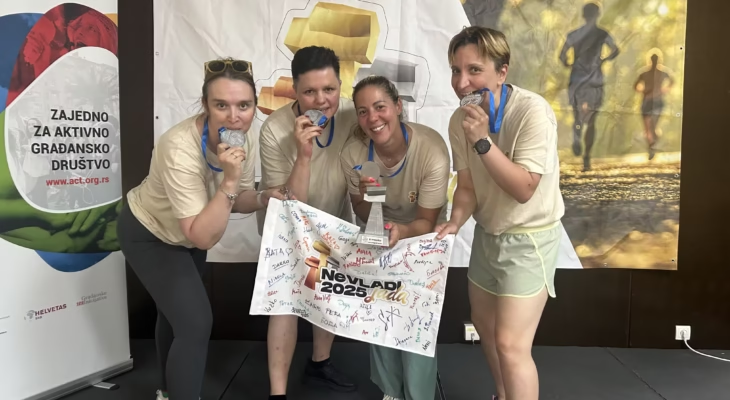
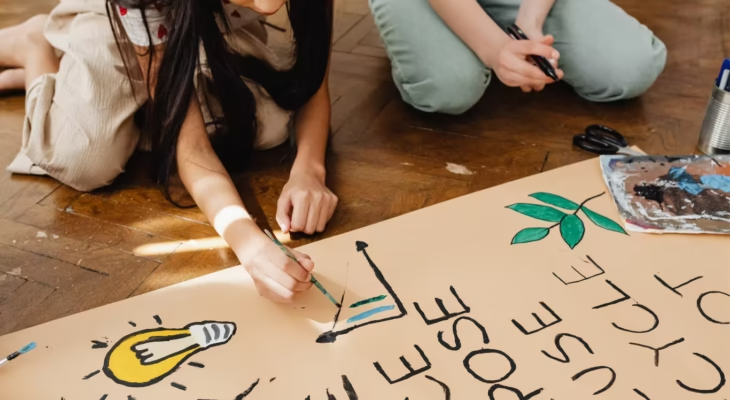
Participants at a workshop supported through the ACT project
2. How are local civil society organizations and independent media supported by ACT strengthening citizen participation and trust in democratic processes at the community level?
One of the most persistent challenges facing civil society in Serbia is not only political pressure, but also the narrative surrounding it. For years, organizations like those we work with have been portrayed in pro-government media as foreign mercenaries, traitors, and forces working against ordinary people. That narrative is intentional. And it remains powerful.
However, over the past two years, as civic protests have grown across Serbia, trust in civil society has started moving in a different direction. Not because the narrative disappeared, but because CSOs moved closer to people. They were present. And people noticed that.
Many organizations supported by ACT fundamentally changed the way they communicate. They moved away from donor language and closer to the language of the communities they serve. They learned new methods of citizen engagement, went directly among people, and invited them to participate in their work instead of merely sending them reports.
Trust is also built through action during important moments. When people were unlawfully detained during protests, CSOs provided legal aid. When democratic processes started deteriorating, they were often the first to publicly and clearly point it out. Such presence builds trust that no media narrative can easily erase.
The results are tangible: more than 150,000 people have directly benefited from the work of organizations supported by ACT. These are people whose lives were touched by organizations that stood beside them, within their communities, when it mattered most.
What we are witnessing today is a slow but genuine redefinition of what civil society means to ordinary citizens. It is becoming something people turn to, trust, and increasingly choose to join.
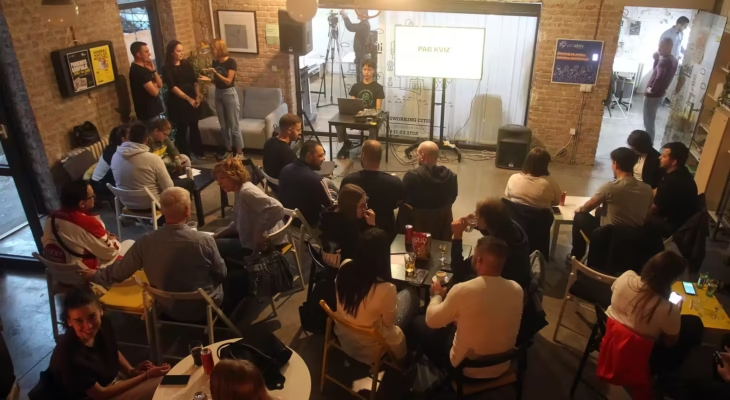
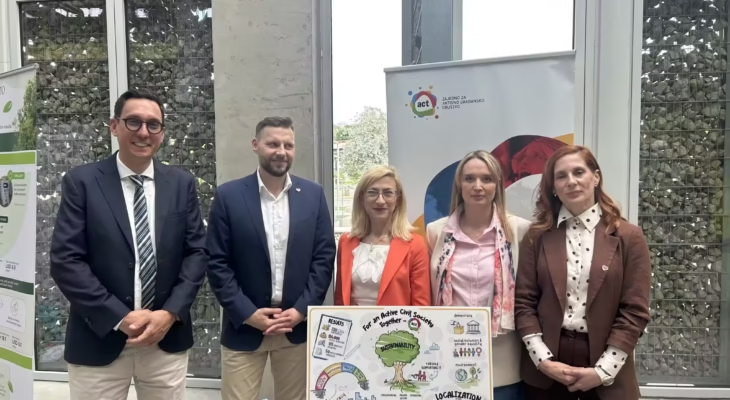
Discussion with informal environmental groups supported through ACT
3. In a highly polarized context, what practical entry points do you see for rebuilding dialogue between civil society, media, and public institutions while preserving their independence?
Let me first be honest about the context. The space for genuine dialogue between civil society and state institutions in Serbia has not merely narrowed. In many areas, it has practically closed. The gap is widening. Transparency is declining. And for many organizations, the experience of formal participation has become an exercise in frustration, where their presence is tolerated but their proposals are ignored.
And yet, CSOs continue to show up. Not out of naivety, but out of principle. What we see among organizations supported by ACT is a deep conviction that respecting the rules matters, even when those in power fail to respect them. That civil society belongs at the table — not because the table itself is fair, but because there are people in that room who have no other representatives. Women who survived violence. Persons with disabilities. Marginalized communities whose lives depend on whether laws are written well or implemented badly.
These organizations cannot afford to give up, because their beneficiaries cannot afford it either. They need ministries to respond. They need laws to function. That is why they remain engaged — not as partners of the authorities, but as advocates for the people the authorities are supposed to serve.
And sometimes persistence produces results. That was the case with the appointment of new members of REM — Serbia’s Regulatory Authority for Electronic Media. The process was flawed. Civil society representatives were not selected properly according to regulations. The conditions were unfair. But civil society remained involved nonetheless. And that persistent, principled participation prevented a complete institutional takeover. It slowed down a process that, without any civic presence, would have moved much faster and much further. It was not a victory. But it was a defended line.
That is the practical entry point we have found in highly polarized societies: to remain present, remain principled, and make the cost of exclusion visible. Not every working group will produce results. The organizations we work with understand that their independence is not threatened by engagement. It is threatened by withdrawal — by disappearing from the very processes that shape people’s lives.
Rebuilding dialogue is a long-term process. It requires a civil society that is financially resilient enough not to be bought, principled enough not to be co-opted, and deeply connected enough to communities that it cannot be dismissed as irrelevant. That is exactly what ACT invests in — and why, even in this environment, we remain cautiously, stubbornly hopeful.